US Bank Holding Companies & Commodities

It turns out that US bank holding companies (“BHC”) are required to file Form FR Y-9C with the Federal Reserve. The information collected is used by the regulators to assess and monitor the financial condition of holding company organizations, which may include parent, bank, and nonbank entities. It is primarily an analytical tool used to monitor financial institutions between on-site inspections. The following link is to a list of the largest US bank holding companies. Follow each bank’s link and select the form FR Y-9C to see the data for yourself.

Federal Reserve Form FR Y-9C

There is commodity level  data for the US BHCs in this form. More specifically, it has the following data for some active commodity banks as of December 31, 2015. All data in thousands US$

Bank  Trading revenue -from cash instruments and derivative instruments

(thousands US$)

Item 9a Gross fair value of commodity contracts

(thousands US$)

Gross fair value of physical commodities held in inventory

(thousands US$)

JP Morgan          $842,000          $23,713,000          $4,657,000
Bank of America          796,000            1,697,500                11,800
Wells Fargo            92,000            5,519,000                         –
Citibank          750,000          18,010,000          1,330,000
Goldman Sachs      1,687,000          20,674,000          3,935,000
Morgan Stanley      1,026,000          17,152,000              321,000

JP Morgan claim to have sold their physical business yet retain a $4.6 billion exposure to physical commodities held in inventory. Perhaps their putative exit of physical commodities was only the transportation/movement of them?

Weekly update – Feb 12, 2016

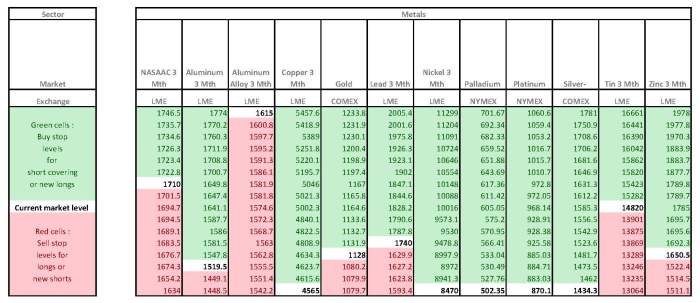
CTA market entry/exit levels: marketlevels_0212

Interesting observation – Almost two-thirds of all markets are at “all in” mode, meaning that all models are either fully long (fixed income, gold) or fully short (commodities). You may wonder how could CTAs would buy more of their longs and sell more of these shorts? I know of two ways – if new money is allocated to the CTA space or if market volatilities were to decrease. It’s important to note that most CTAs utilize some form of volatility targeting which means they reduce position sizes as an individual market’s volatility increases. The contrapositive would be they would increase their position sizes as an individual market’s volatility decreases.

European family holding companies

Sometimes we search for individual investments when great investors are being ignored right at our doorsteps.  Berkshire Hathaway is the granddaddy of them all but there are quite a few mini-Berkshires.  In North America, most value investors are familiar with Leucadia, Loews, Danaher, Platform Specialty Products but interestingly enough, there are a number of publicly listed European holding companies that wealthy European families use for their investments.

Pargesa Holdings (Belgium — Baron Albert Frere;  Canada — Paul Desmarais)

Pargesa is a holding company formed by Albert Frere and Paul Desmarais in 1981. The company has a unique background in that it was formed  to avoid the nationalization of Paribas by the newly elected socialist president Francois Mitterand. The holdings are displayed in the chart below (see 2015 Pargesa Annual General Meeting ).
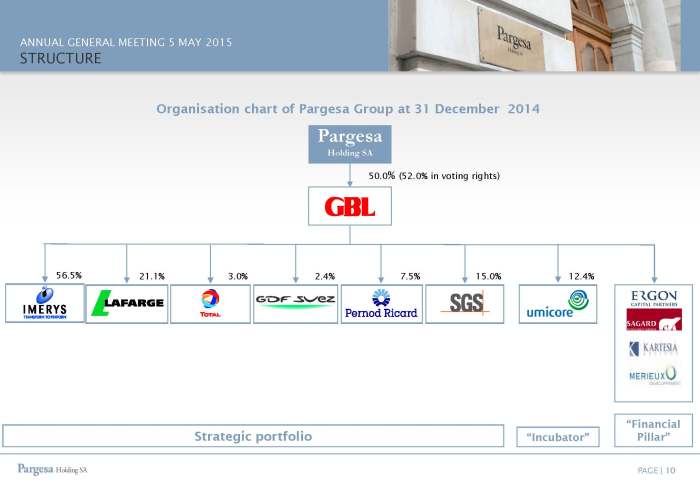
ag15en_Page_10

Interesting enough, the holding company has traded at a discount to NAV since the mid 2000s (see GBL stock price vs NAV ).

Pargesa, GBL & Power Corp of Canada

Billionaire Frere

Wendel (France — Wendel family)

Founded in the France in 1704, the Wendel Group developed its business over more than 300 years in diverse industrial sectors, mainly steelmaking. At the end of the 1970s, the French government nationalized all of their steel production activities. Wendel, a pioneer in private equity, then turned its focus to long-term investing.

History and background on the family & company can be found on their website.

 Wendel Group history

The holdings are displayed in the chart below ( see 2015 Wendel Group Investor Day ).
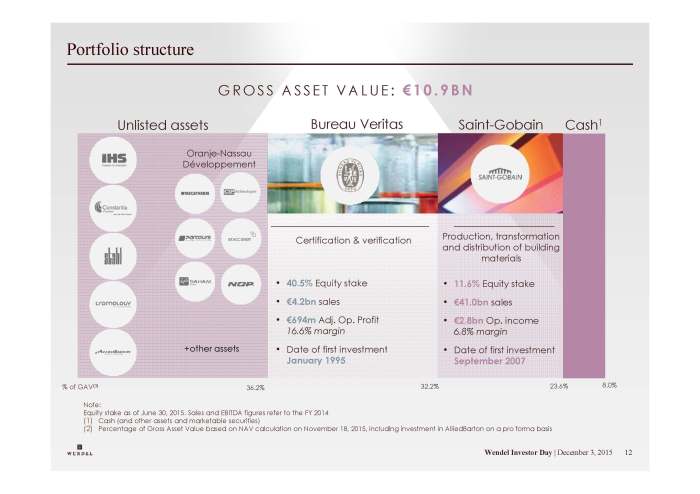
1_wendel_wendelid2015_jm_1_Page_12(Interesting side note for UK residents – Saint Gobain is the parent company of the large UK building supplier Jewson).

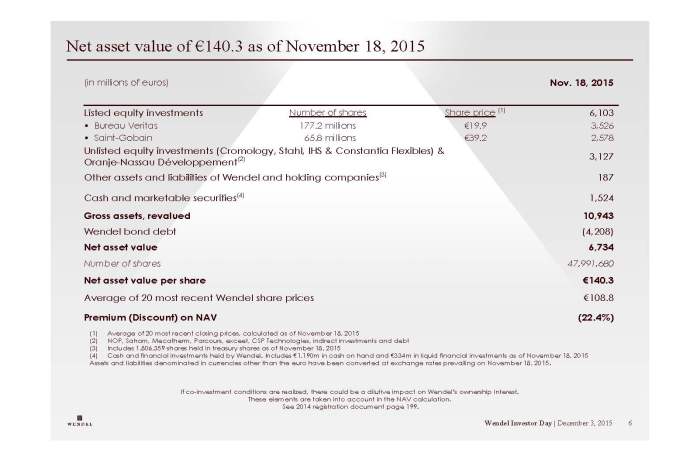
Unlike several other European family holding companies, the Wendel Group has a significant allocation to unlisted (private) companies.
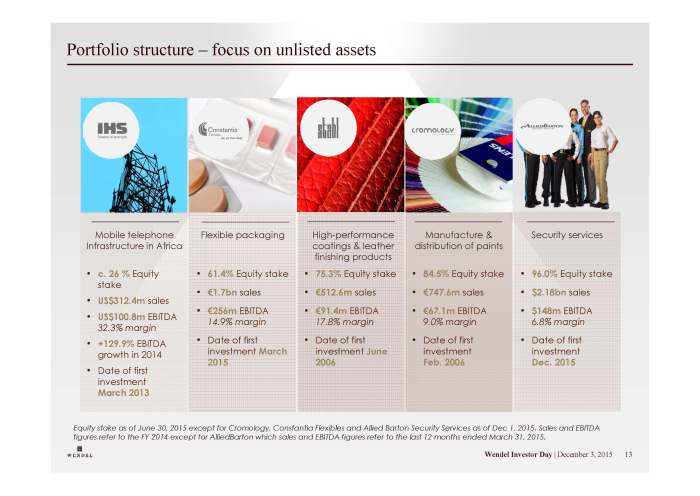
1_wendel_wendelid2015_jm_1_Page_13

Similar to Pargesa, the Wendel Group trades at a discount to NAV (see Wendel Group – stock vs NAV ).
1_wendel_wendelid2015_jm_1_Page_06Exor (Italy — Agnelli family)

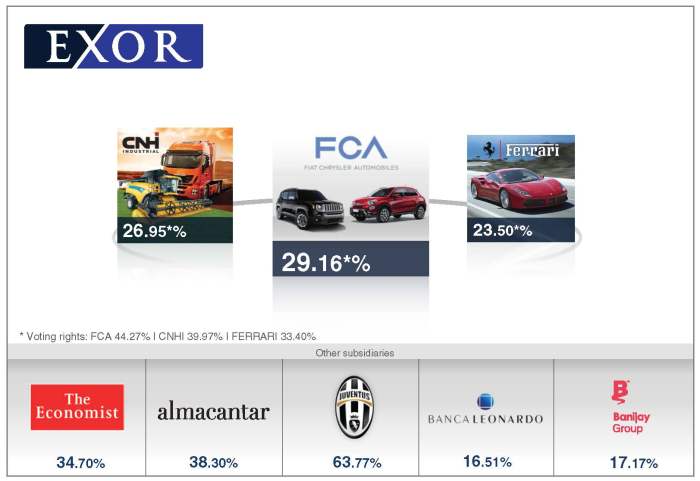
Exor is a holding company controlled by the Agnelli family that owns interests in the companies in the slide below.
 

portafoglio_investimenti_en (1)

John Elkann, the Chairman and CEO, appears to be building an Italian Berkshire Hathaway with his investing style.  He even pens a genuine letter to his shareholders 2014 Letter to shareholders

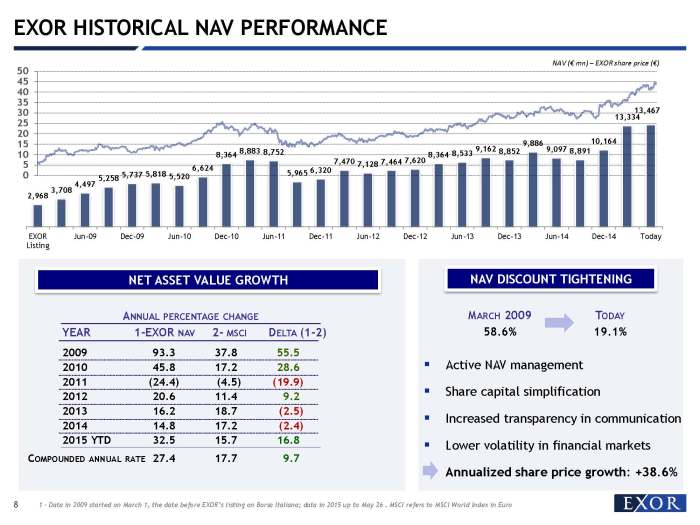
Once again, the holding company trades at a discount to NAV. I believe the discount is now circa 15% using NAV data as of Sep 2015. Here’s a slide of the stock & NAV performance as of May 2015 (See  May 2015 Investor Call ).May29 ConfCall FINAL (3)_Page_08
Investor AB (Sweden — Wallenberg family )

Founded by the Wallenberg family a hundred years ago, Investor is the leading owner of high quality Nordic-based international companies. Investor was founded 1916 and spun out of Stockholms Enskilda Bank.  From 1916 to the early 1970s, Investor was part of Stockholms Enskilda Bank, which had been managed by the Wallenberg family ever since the bank was founded in 1856. Later, Investor gradually developed into a holding company with independent operations. .

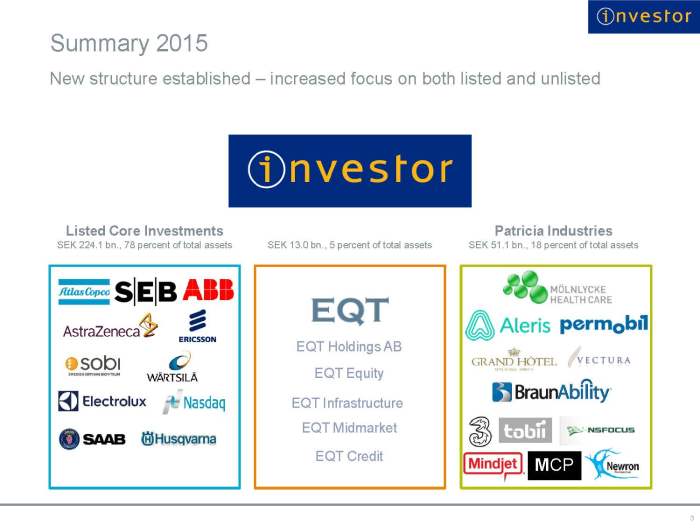
Today, they have diverse holdings in leading Nordic companies ( 2015 Investor AB presentation ). In many cases they are the largest shareholder of the listed company.
investor_year-end_2015_presentation_Page_03

2015 Year end report

Wallenberg family

Investor AB & Wallenberg family

Once again this trades at a discount to NAV as well. Some people may argue that the dual share class structure with Investor AB is the source for some of the discount.

Summary

One could argue that investing in such holding companies is a lazy way to invest but I have no problem  conceding that these firms excel at creating shareholder value over generations. Whether or not one invests, one can certainly learn something from watching and analyzing their investment approach.
 

Basic CTA models … Stop loss levels

I ran a Commodity Trading Advisor (“CTA”) many years ago and an interesting output of our trading models were the stop loss levels. It turns out that most CTAs are trend followers, looking to exploit momentum in the commodity and financial future markets. As such, there’s a high degree of overlap between most CTAs performance and entry/exit timings.

Most CTAs will run a number of models & parametrizations on a given market. For instance, they could have 5 different models to measure momentum with 6 different parametrizations each to account for different time frames. As such, a total of 30 different signals could be generated for each market. The aggregated position will be the sum of the 30 different signals.

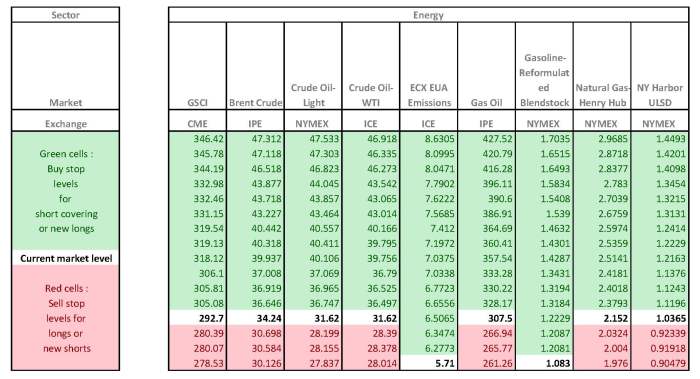
It is particularly interesting when a market became offsides. In other words, a vast majority of the signals are long or short. This usually means the CTA/trend following community is all in. Then, when these markets reverse you know there could be a vast amount of stop loss selling or short covering, as well as any potential new signals to go short or go long.  Quite often, these levels are good predictors of heightened market volatility. As such, I used to always keep an eye on them to see which markets had the most potential for an explosive move.

In the table below I’ve listed out these stop loss levels for various energy and metal futures markets. The green cells highlight the levels of stop loss buying. This would either be short covering or entering new longs. The red cells highlight the levels of stop loss selling. Once again, this could be long liquidation or new shorts. The white cells in bold provide current market levels.

The link below is to a spreasheet that contains the levels for a bunch of other markets – agriculture products, equity products, fixed income products, soft commodities, etc.

energylevels_0201

metallevels_0201

marketlevels_0201

WL Ross Holding Corp.

Wilbur Ross has a Special Purpose Acquisition Corp (“SPAC”) set to expire this year if he doesn’t do a deal in H1 2016.  The units trade under WLRH, warrants under WLRHW and the units + 1/2 a share of warrants under WLRHU.

Here’s some background & analysis on the SPAC

Wilbur Ross SPAC

WL Ross Holding Company

& the original prospectus

SEC filing

Like most SPACs, if there is no deal, your money is returned. At the moment, the cash value is close to $10 which is exactly where the WLRH units have been trading. So worst case, you get your money back + a refund of the underwriting fees (unusual but good). Best case, Wilbur Ross does something clever in the energy sector and it’s worth more…… Dare I say, a cheap option?

Employee temperment

Hire a good boss. Good bosses see through bullshit and don’t tolerate it. They run results oriented meritocracies. Bad bosses are bad decision compounders.

Employees often think too highly of managers who like or promote them. It’s natural. We like those who like us. As a consequence, one may stay too attached to a manager or team because of this even though the manager may not be that effective. Yes, a manager can be ineffective in terms of business strategy but competent enough to recognize talent. One unintended consequence would be for a high performing employee to stay too loyal to mediocre manager.

Spend 15 minutes at the beginning of every day thinking about your work priorities. Think through what you have to do for others in the short & long run but most importantly, dedicate time to think and work on tasks that you assign yourself. Work that you know will improve the business.

If you find yourself always on the Inbox treadmill, you’re letting others set your priorities and time management.

People struggle with uncertainty. I have had personal setbacks in life that forced me to deal with uncertainty but some people haven’t. Know your team and assign tasks & roles accordingly.

Meet failure early in your life and develop the emotional tenacity to plough through adversity.  Help foster a similar culture among your colleagues.

Any and all interactions should be based upon what if the tables were turned. What if I was on the other side of the negotiating table? Review? Meeting? Strive for a fair outcome regardless of your position, even if it means leaving something on the table. Why? Because mutually acceptable solutions are the only durable outcome.

Being candid is not easy and takes effort. Best done straight up, one to one.

Intellectual honesty is hard for many people. Their identity and self-confidence is too wrapped up in the situation to be intellectually honest. Most people think they are special, their product is special or their service is special. Unfortunately, the vast majority of people, products and services are in the “me too” category. Undifferentiated & indistinct. Don’t drink the Kool-aid

Integrity over ability any day of the week, all year long.

Everyone can have a moan or whinge but get on with it. People who point out problems are a dime a dozen. Find and propose solutions.

If you walked into your kitchen and saw a spilt milk carton, you’d clean up the mess. Do the same at the office. When you see something is broken, literally or not, fix it.  Treat it like it was your own home.

If you wouldn’t say it to their face, don’t say it in their absence.

Conduct yourself at all times as if everyone had transparency into what you were doing. Whether that be your clients, colleagues, boss, regulators, etc.

Business strategy

There are no short cuts to a good business model.

If you keep employing the same strategy and don’t get the result you want, try any other strategy.  I picked this up from playing squash. If you keep playing a drop shot and your opponent handles every drop shot, it makes no sense to continue doing the same thing. Try anything but the drop shot!

There are 6-7 billion people on this planet. You will continue to be surprised by both the positive and negative qualities of people.

Base your strategy on what won’t change. Here’s an excellent quote from Jeff Bezos.

“I very frequently get the question: ‘what’s going to change in the next 10 years?’ And that is a very interesting question; it’s a very common one. I almost never get the question: ‘what’s not going to change in the next 10 years?’ And I submit to you that that second question is actually the more important of the two – because you can build a business strategy around the things that are stable in time….in our retail business, we know that customers want low prices and I know that’s going to be true 10 years from now. They want fast delivery, they want vast selection. It’s impossible to imagine a future 10 years from now where a customer comes up and says, ‘Jeff I love Amazon, I just wish the prices were a little higher [or] I love Amazon, I just wish you’d deliver a little more slowly.’ Impossible [to imagine that future]. And so the effort we put into those things, spinning those things up, we know the energy we put into it today will still be paying off dividends for our customers 10 years from now. When you have something that you know is true, even over the long-term, you can afford to put a lot of energy into it.

 “On AWS [Amazon Web Services], the big ideas are also pretty straightforward. It’s impossible for me to imagine that 10 years from now, somebody’s gonna say, ‘I love AWS, I just wish it were a little less reliable.’ Or ‘I love AWS, I just wish you would raise prices…’ Or ‘I love AWS and I wish you would innovate and improve the APIs at a slightly slower rate.’ None of those things you can imagine.

“And so big ideas in business are often very obvious, but it’s very hard to maintain a firm grasp of the obvious at all times. But if you can do that and continue to spin up those flywheels and put energy into those things as we’re doing with AWS, over time you build a better and better service for your customers on the things that genuinely matter to them.”


Management

How does senior management choose or evaluate their managers?

At a certain level in the corporate hierarchy, the vast majority of mid-level managers are intelligent, articulate, and professional. Many managers of managers rely upon these attributes in evaluating the managers that work for them. This is a colossal mistake. Being effective at one’s role is not an inevitable consequence of being intelligent, articulate or professional. Without tangible, objective measures of success, thick layers of corporate management become populated with smooth talkers or political mavens. If you are a manager of managers, it is imperative you base your evaluation of each manager on their actual performance. What did they accomplish over the short run? Over the long run? What successes? What failures? How much planning or driving did they do versus you having to ask them to do something?

Another colossal mistake that managers of managers make is not kicking the tires on their managers. Go one or two levels below to hear feedback. Otherwise, you’ll never know if you have someone who manages up very well but is poorly regarded by his colleagues or direct reports. Granted, this is not a popularity contest but one need only consider the fair and objective feedback on the manager. That a manager is tough or demanding is not really a criticism.

Do not overvalue the loyalty of your managers at the expense of their competency when placing them in important roles. All too often, a very senior manager wants to surround themselves by people they trust. This desire often leads to the senior manager placing a long-time colleague in a senior role without really asking the critical questions above – Is this person competent at this role? Have I checked with the teams below for feedback? Having loyal and trust worthy direct reports is imperative but not at the cost of competency. A loyal clown is still a clown. No quality employee will want to work for or with a clown for a long time.

Ask yourself one basic question when you evaluate your team. If you could do it all over again would you hire them again for the same job? If not, you can’t leave the situation alone. You’ll need to act and either find a new role for the questionable ones or let them go.

People respect fair but firm.