Reed Hastings, the CEO of Netflix, has just published a book No Rules Rules : Netflix and the Culture of Reinvention. If this book is anything like his slidedeck on Culture and HR practices then it will certainly be a great read.
Unbeknownst to many, Netflix has not always been what it is today. It started life as a mail order DVD service. Which serves as a nice introduction and segue to the topic of corporate transformations.
Look through a company’s Investor Relations material and you will quickly see that most believe they can and will transform themselves into something different to what they have been for most of their existence. There normally will be all sorts of inspirational and energetic language to galvanise their employees towards the new world and frown upon the naysayers who say it can not be done. Quite often, the aspirational end states come in cycles. In the late 1990s it was all about the Dot.com economy and today it is all about fintech, electric vehicles and ESG. But the reality is transforming an existing company is extremely hard and extremely rare. The vast majority, more than 95%, will fail to transform themselves into something bigger or better notwithstanding all of their good intentions and marketing material saying otherwise. Why is that?
For starters, let’s see what lessons can be learnt from the past. In the late 1990s, Amazon was just a book selling platform and already a clear threat in plain sight for Barnes & Noble and Borders in the US and eventually Waterstones in the UK. Did Barnes & Noble, Borders or Waterstones transform themselves because of this threat? Or did they believe they had an unassailable business model which provided them a false sense of business security? What about the camera industry? With cameras ubiquitous on every smartphone, the need for a dedicated camera and film were greatly reduced. What did Kodak, Fuji Film, Canon, Nikon do? Were they able to transform themselves? Fast forward a few years and eventually Amazon moved beyond books into other areas of retail. Did Walmart, Target or Best Buy fundamentally or radically change their business models to prevent themselves suffering the same fate as the book sellers? After all, these retailers had the good fortune of seeing how the early innings went between Amazon and the book sellers. What about Blockbuster? Remember the place that you used to go to rent a DVD? Did they see the threat of online video on demand and transform? Sadly, in all of these instances the answer was no. They didn’t fundamentally transform their business into a better or bigger business. That’s not to say that it never happens. Some companies have succeeded. IBM did it. Apple did it. And more recently, Netflix did it too.
As mentioned earlier, Netflix has not always been what it is today. It started life as a mail order DVD service with all the attendant challenges and costs of mailing and receiving physical DVDs. Back in 2011, Reed Hastings, Netflix CEO, realized the future of mail order DVD was futile and made a startling decision to partition the company into a mail order DVD entity, Qwikster, and the streaming Netflix that we know of today. Mind you, this was nearly a decade after being in business, having positive net income and meaningful net income growth. At the time, he stated,
“For the past five years, my greatest fear at Netflix has been that we wouldn’t make the leap from success in DVDs to success in streaming. Most companies that are great at something – like AOL dial-up or Borders bookstores – do not become great at new things people want (streaming for us) because they are afraid to hurt their initial business.Eventually these companies realize their error of not focusing enough on the new thing and then the company fights desperately and hopelessly to recover. Companies rarely die from moving too fast, and frequently die from moving too slowly.”
– Reed Hastings, NETFLIX CEO
How many firms would be convinced that the old (DVD) is dead and that the new (streaming) will displace the old and be willing to cannibalize their core business? There may not be confirmation for the success of their strategy for years during which time they will surely face the ire of investors?
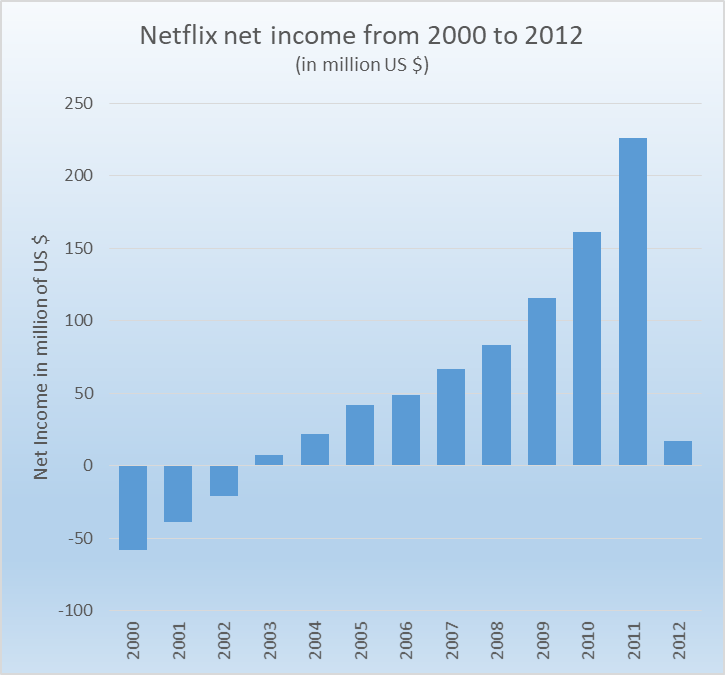
In Netflix’s case, they went from $200+ million of net income in 2011 to less than $20 million in 2012.
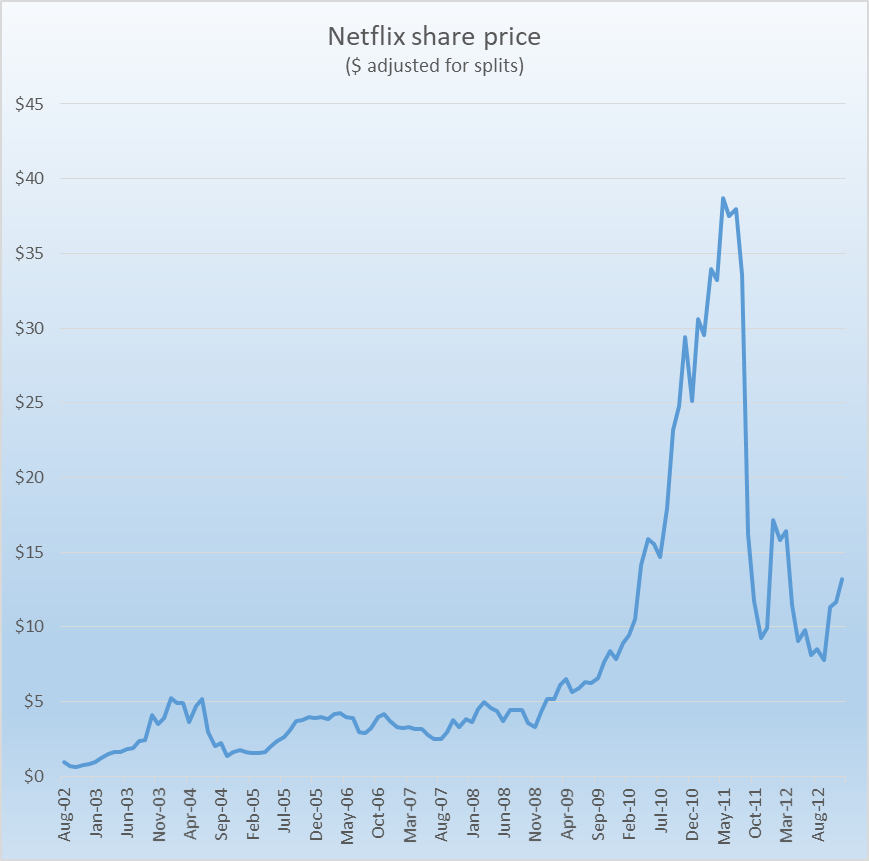
And their stock price decreased nearly 80% after the turn in strategy in 2011.
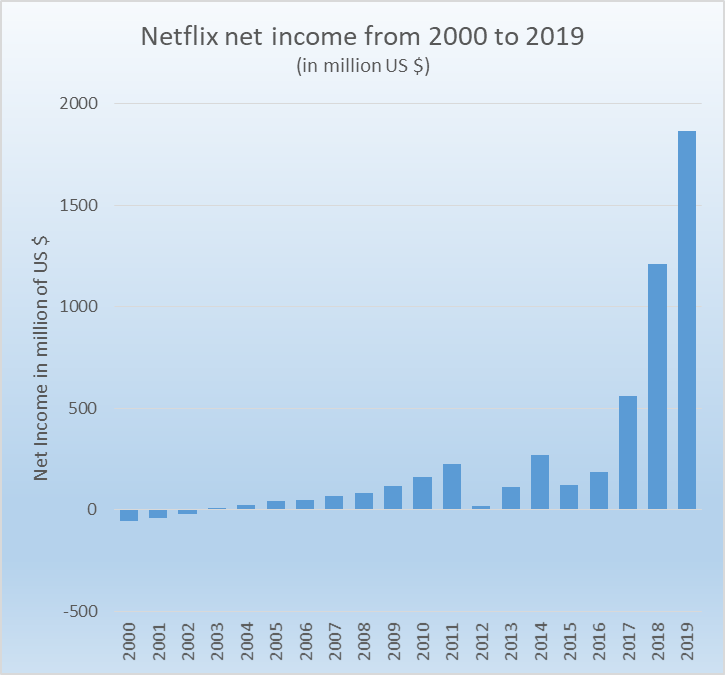
It wasn’t until 2017, a full 6 years later, that Netflix compellingly exceeded their 2011 net income of $200+ million with an eventual growth to nearly $2 billion of net income in 2019, 9 years after the fateful decision to ditch the physical DVDs.
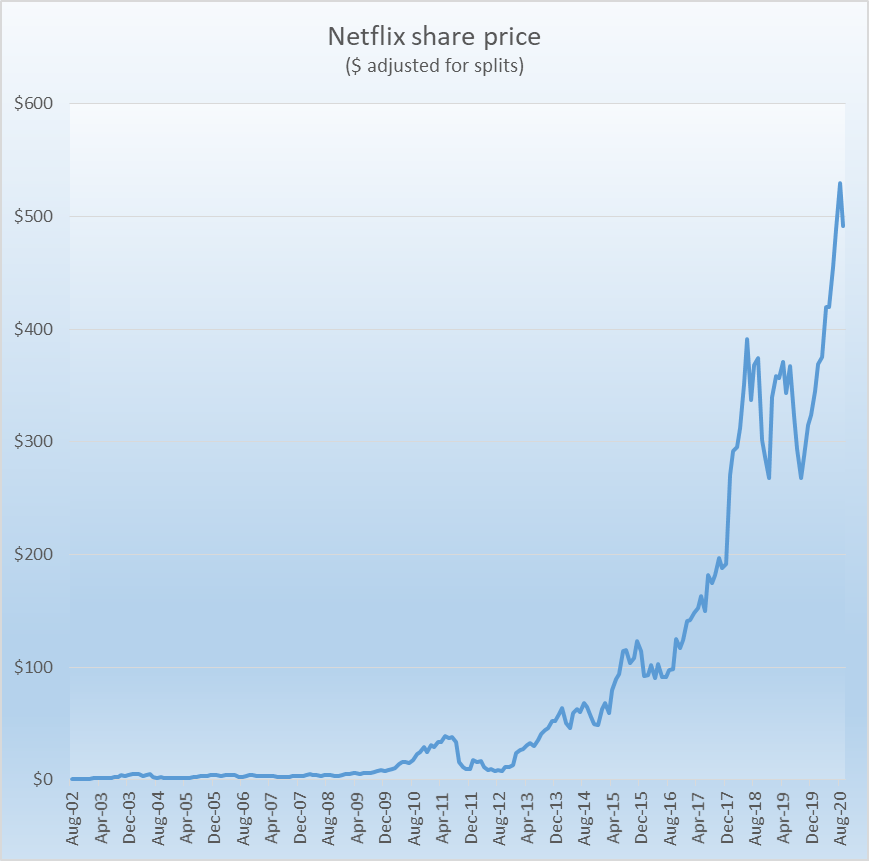
After an initial share price drop, Reed Hastings was ultimately vindicated for his pivot in strategy and transformation from 2013 onwards. And boy was he ever vindicated.
For those familiar with Reed Hastings, this may not come as a surprise. As his slidedeck on business and culture highlighted his independent and orthogonal thinking, which ultimately is the foundation of any successful turnaround or transformation.
The real question is how many other CEOs are willing to temporarily go backwards financially, face shareholder opprobrium for several years and possibly be replaced before their transformative strategy is ultimately vindicated? Put that way, it’s no surprise that there are so few turnarounds or transformations.
“The day before my inauguration President Eisenhower told me, You’ll find that no easy problems ever come to the President of the United States. If they are easy to solve, somebody else has solved them. I found that hard to believe, but now I know it is true.
“If a man will begin with certainties, he shall end up in doubts; but if he will be contet to begin in doubts he shall end in certainties.”
– Sir Francis Bacon
Just a few business and other books that may be of interest …
Business biographies
Baruch, Bernard M. (1957). Baruch. My Own Story. Buccaneer Books.
Landley, Monica. (2003). Tearing Down the Wall. How Sandy Will Fought His Way to the Top of the Financial World and then Nearly Lost It All. Wall Street Journal Books.
Rochichaux, Mark. (2002). Cable Cowboy. John Malone and the rise of the modern cable business. John Wiley & Sons.
Zell, Sam. (2017). Am I Being Too Subtle? Straight Talk From a Business Rebel. Penguin House LLC.
Accounting
Accounting is the language of business. If you can’t read and understand basic financial statements, you won’t be able to ascertain the value of a company. That doesn’t mean you need to have an accountant’s level of understanding just like you don’t need to be an English literary scholar to read, speak and understand English.
Bandler, James. (1994). How to Use Financial Statements – A Guide to Understanding the Numbers. McGraw Hill.
Friedlob, George T. and Welton, Ralph E. (2001). Keys to Reading an Annual Report. 3rd edition. Barron’s Educational Series.
Graham, Benjamin and Meredith, Spencer B. (1937). The Interpetation of Financial Statements. HarperCollins Publishers.
Mulford, Charles W. and Comiskey, Eugene E. (2005). Creative Cash Flow Reporting – Uncovering Sustainable Financial Performance. John Wiley & Sons.
O’Glove, Thornton L. (1987). Quality of Earnings – The Investor’s Guide to How Much Money a Company is Really Making. The Free Press, Macmillan, Inc.
General business interest
Ahamed, Liaquat. (2009). Lords of Finance. The Bankers Who Broke the World. Penguin Press.
Biggs, Barton. (2008). Wealth, War & Wisdom. John Wiley & Sons.
Galbraith, John Kenneth. (1954). The Great Crash 1929. Houghton, Mifflin Company.
Kessler, Andy. (2004). Running Money. Hedge Fund Honchos, Monster Markets and My Hunt for the Big Score. HarperCollins Publishers.
Sambrook, Geoffrey. (2002). Tarnished Copper. Twenty First Century Publishers Limited.
Smith, Adam. (1967). The Money Game. Vintage Books, Randon House.
Yergin, Daniel. (2009). The Prize – The Epic Quest for Oil, Money & Power. Simon & Schuster.
By 1917 the war in Europe had been underway for three years and death was no stranger to the continent for several million soldiers had already died. The United States finally entered World War I in April 1917 when the Zimmerman documents were captured. These documents revealed the German foreign minister Arthur Zimmerman had proposed to Mexico that it join Germany in war against the Unites States and reclaim parts of New Mexico, Texas and Arizona. The US and its president, Woodrow Wilson, mobilized for war. The Selective Service Act of 1917 authorized the government to raise a national army through conscription and soon there were young soldiers in training camps across the country.
Thus was set the stage for the 1918 Spanish Flu Pandemic. Sadly, the tragic loss of life and missteps that occurred during the ensuing years were exacerbated by the shackles of cognitive biases we as humans find hard to break free from. Namely, evaluation apprehension, authority bias, anchoring and confirmation bias. It would not be until the 1950s, 1960s and 1970s that these biases would be researched and discovered so world leaders in 1918 could be partly absolved for their mistakes.
Fast forward to today and notwithstanding the advances of modern medicine and our knowledge of these cognitive biases, we face the same behavioural biases from 1918 yet made similar errors as we contend with COVID-19. We are still in the early stage of our fight against COVID so arming ourselves with a bit of knowledge will protect us from repeating many of the errors of the past and any new errors as well.
INEVITABLE SPREAD OF THE VIRUS
Military bases
As the US entered World War I, war mobilization drew millions of civilians into military institutions and extended the military into all corners of the country. To train and supply these men, the Army and Navy expanded their training facilities. Military camps sprouted up in every state. Camp Funston in central Kansas is where the first soldier known to have influenza reported ill in March 1918 and within weeks thousands of soldiers were admitted to the hospital. Sadly, infected soldiers carried the influenza from Camp Funston to other Army camps in the States before carrying the disease overseas. It was during the fall of 1918 at Camp Devens, outside of Boston, Massachusetts, that the influenza erupted like never before. By late September, nearly 20% of the entire camp was on sick leave with nearly 75% of those sick in hospital. Medical experts recommended a halt to transfers in or out of Devens until the epidemic passed. But before the travel ban could be imposed, a contingent of replacement troops departed Devens for Camp Upton in Long Island, the Army’s debarkation point for France, and took the flu with them. Within days, Camp Upton was soon overwhelmed. In an effort to contain the outbreak, Camp Upton’s commander put its inhabitants under quarantine, banning travel in and out except for the most urgent business. But in war, there is much urgent business and people got through. And so continued the spread of the epidemic from military camp to military camp across the country. Influenza reached all Army training camps in a month, arriving on the West coast by early October 1918.
Acting Army Surgeon General Charles Richard recommended to Army Chief of Staff Peyton March that all troop movements overseas be suspended but March only agreed to a 10% reduction in crowding on troopships. The controversy reached the White House when President Wilson asked March why he refused to stop troop transport during the epidemic. March described the Army’s screening precautions and invoked the exigencies of a war of attrition, pointing out “…the psychological effect it would have on a weakening enemy to learn that the American divisions and replacements were no longer arriving.” Troop shipments should not be halted for any reason, he told Wilson, and the president deferred to his judgment. March and Wilson had no intention of hindering U.S. participation in the war.
Civilian population
Influenza festered in cantonments before spreading to the surrounding civilian populations. Regrettably , the civilian response was equally as ineffective in halting the epidemic. Time after time, city or state officials lost valuable time in halting the spread of the disease. No place was this more apparent than in Philadelphia. Four days after the arrival of sailors from Boston at the Philadelphia Navy Yard, sailors reported ill with symptoms of influenza. The epidemic was sweeping through the Philadelphia naval installation with the same virulence it displayed at Camp Devens.
Yet in Philadelphia, public health director Dr. Wilmer Krusen did absolutely nothing. Krusen publicly denied that influenza posed any threat to the city and would not heed the advice of leading scientists to issue a city wide quarantine. Public health officials assured the public that they would “confine this disease to its present limits, and in this we are sure to be successful. No fatalities have been recorded among Navy men. No concern whatsoever is felt by either the military and naval physicians or by civil authorities.” A few days later it was declared that the “disease has about reached its crest. We believe the situation is well in hand. From now on the disease will decrease.” Tragically, a Liberty Loan parade would be held a week later with the sole purpose of selling millions of dollars of war bonds to the civilian population. It was to be the greatest parade in Philadelphia history with thousands marching and hundreds of thousands watching it.
One cannot look at the 1918 influenza pandemic without understanding the historical backdrop – the US and Europe were waging total war. War requires sacrifice and good morale makes sacrifice acceptable. These sacrifices would impact people’s daily lives with various forms of voluntary or forced rationing taking place. The government also compelled conformity and controlled speech in ways not known in America before or since. Soon after the declaration of war, Wilson pushed through the Espionage Act and a new Sedition Act which made it punishable by twenty years in jail to “utter, print, write or publish any disloyal, profane, scurrilous, or abusive language about the government of the United States.”
So it was upon Dr Krusen’s deaf ears that several leading physicians in Philadelphia urged the cancellation of the parade. No newspaper would inform the public that the parade would spread influenza even after several leading medical experts pleaded with the papers’ editors. For such a comment might hurt morale or be considered seditious.
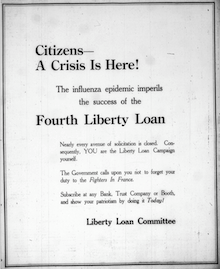
Instead, the papers carried a full page advertisement by the Liberty Loan Committee stating “The influenza epidemic imperils the success of the Fourth Liberty Loan…. The Government calls upon you not to forget your duty to the Fighters in France.”
SOURCE/THE PHILADELPHIA INQUIRER
The incubation period of influenza is a few days. Two days after the Liberty Loan parade, Dr Krusen issued a statement that the epidemic was now in the civilian population. Within three days, every single bed in each of the city’s thirty-one hospitals was filled and over a hundred people died in a single day. Soon the daily death toll from influenza alone would exceed the city’s average death toll from all causes. Only five days after the parade, Dr Krusen banned all public meetings in the city and closed all churches, schools, and theaters. Within a week, 45,000 Philadelphians were infected with influenza. Within six weeks, more than 12,000 Philadelphians were dead.
Evaluation apprehension, authority bias and history repeating itself
Authority bias is a cognitive bias that makes people predisposed to believe authority figures and obey orders. Most notably, the authority bias is associated with people’s tendency to obey the orders or respect the opinions of someone that they perceive as an authority figure, even when they believe that there is something wrong with those orders or opinions, and even when there would not be a penalty for defying them.
Yale psychologist Stanley Milgram conducted the first and most infamous study on the authority bias in the 1960s, some 40 years after the Spanish Flu epidemic. In this experiment, Milgram measured the willingness of study participants, men from a diverse range of occupations with varying levels of education, to obey an authority figure who instructed them to perform acts conflicting with their personal conscience. Participants were led to believe that they were assisting an unrelated experiment, in which they had to administer electric shocks to help people learn. These fake electric shocks gradually increased to levels that would have been fatal had they been real. The experiment found, unexpectedly, that a very high proportion of subjects would fully obey the instructions even when they felt that it was wrong, and even when they wanted to stop, because they felt pressured by the perceived authority of the person leading the experiment.
During the 1918 Influenza, time after time, in city after city, and camp after camp, civilian or military officials in positions of power were afraid of overreacting to the situation, alarming the public and challenging authority. For a camp commander, it would have been a brave step to defy the chain of command and refuse troop movements to and from their own camp without the support of their seniors. For the military leaders, it would have been a bold step to inform the president that there would be delays in shipment of troops to Europe while they implemented a quarantine. The exigencies of war were far too great to pause for social distancing and quarantines to control the epidemic. Likewise, for cities and state officials, the mayors, governors and health service directors, it would have required courage to be the outlier amongst all of the various states and cities in America and to cancel all public gatherings in your city or state. After all, they were elected officials who depended on the voting public to keep them in their roles.
Sadly, the fear of seeming to overreact, challenge authority figures and place your career at risk was far too great for most military or civilian leaders in 1918. Their default decision was to go with the herd and do what everyone else was doing. Unfortunately, that cost lives in 1918 and once again in 2020. As COVID-19 began its inexorable spread across the globe in January and February 2020, world leaders had an opportunity to step in and stem its spread. But this would have required locking down and closing borders far earlier than they did and risking global ridicule if COVID-19 fizzled out instead of spreading. Politicians thrive or wither on the vine of public opinion so the easiest decision was to downplay and delay. The vast majority of them downplayed the seriousness of the pandemic and delayed actions until was deemed acceptable to be impinging on our civil liberties. Tragically, it would all be too little, too late.
While there was not a replay of the Liberty Loan parade in 2020, there were a few notable large public gatherings in the US and UK. President Trump held a controversial indoor rally in Tulsa, Oklahoma on June 20, where many of the attendees reportedly did not wear masks. The event was criticized as being unsafe and three weeks later Oklahoma health officials reported record number of COVID-19 cases, with the 7-day average of COVID-19 cases being nearly six times what it was in early April at the start of the pandemic. More recently, he held parts of the Republican National Party convention in person. In the UK, the four-day Cheltenham Festival was held in March right before lockdown was imposed. Over 60,000 people would have attended in packed stands each of the four days. Unsurprisingly, mortality figures show that local NHS hospitals recorded nearly double the deaths of neighbouring and similarly sized hospitals.
Across the globe, the median number of days before a border closure in a given country or lockdown from the first reported case in China was nearly 80 days and the median number of days before any border closure or lockdown from the first reported case in said country was nearly 25 days. It took on average another 5-6 weeks before the peak daily infections were reached post lockdown. The math is simple. If the governments locked down earlier and more stringently, the outcome would have been vastly improved. Why didn’t they? Even after a century of medical advancement, we as humans are still prone to cognitive biases – we fear being evaluated as having made the wrong decision. And as citizens, we listen and respect authority so when they say it’s under control and safe, we believe them.
FINDING A CURE – THE SCIENCE, SCIENTISTS — ANCHORING AND AUTHORITY BIAS
At the end of the 19th century, one German scientist stood above the rest – Dr. Robert Koch. Koch successfully identified the pathogens for tuberculosis, cholera and anthrax during his lifetime. So it was fitting that the infectious disease giant at the time of the 1918 Influenza would be one of Dr Koch’s brightest disciples – Dr Richard Pfeiffer. Pfeiffer’s reputation was solidified when he isolated bacteria from influenza patients during the pandemic of 1889-90. He now believed that these bacteria, known as Pfeiffer’s bacillus or Bacillus influenza, were the cause of the 1918 influenza and publicly proclaimed this to the medical community. Sadly, this proclamation would misguide the world’s leading scientists for over a decade.
Anchoring is a completely different cognitive bias from authority bias. In anchoring, an individual depends too heavily on an initial piece of information to make subsequent decisions. Once the anchor is set, all future estimates or opinions are discussed in relation to the anchor. Information that aligns with the anchor tends to be embraced, whereas information that is more dissonant tends to be discounted. The anchoring heuristic was first theorized by Amos Tversky and Daniel Kahneman. In one of their first studies in the 1970s, participants were asked to compute within a few seconds the product of the numbers one through eight, either as 1x2x3x4x5x6x7x8 or 8x7x6x5x4x3x2x1 (Answer 40,320). Because participants did not have enough time to calculate the full answer, they had to make a guess or estimate after the first few multiplications. With the increasing sequence, the first few multiplications gave a small answer so the participants gave a smaller estimate (median estimate 512); with a decreasing sequence, the first few multiplications gave a larger answer so the participants gave a larger estimate (median estimate 2,250).
It’s a bacteria
Neither the authority bias nor anchoring bias were known as cognitive biases in 1918. They would only be discovered a half century later but their deleterious effects were felt nonetheless. For Pfeiffer was not only a medical giant at the time but an imperious medical giant at that. His reputation gave his finding tremendous weight and around the world many scientists heeded his admonitions and believed a bacteria, not a virus, was the pathogen. Thus anchoring scientists in a misguided search for a cure.
Pfeiffer’s Bacillus influenza was a difficult bacteria to isolate. It was small, even by the standards of bacteria and needed specific conditions for it to grow in a culture medium. Unfortunately, many investigators around the world could not find the bacteria. So strongly anchored was the a priori opinion that the cause was B. influenza that it soon became a test of a scientist’s skill to isolate and grow Pfeiffer’s bacteria in the laboratory. When a bacteriologist failed to find it in a meaningful percentage of autopsied cases, their failure would be blamed on poor technique. In fact, when one Army bacteriologist failed to find it, a formal investigation into their laboratory’s methods was undertaken. And in camp after camp, bacteriologists fell into line and “found” it. In some instances, instead of exposing themselves to criticism, bacteriologists diagnosed victims of the epidemic as suffering from other diseases instead of influenza to avoid opprobrium.
Leading the medical research charge for a vaccine in the US were the most prominent scientists at the Rockefeller Institute for Medical Research, New York City Department of Public Health, Johns Hopkins, Mayo Clinic, Harvard, Stanford and University of Pennsylvania. Many of these scientists would later be awarded the Nobel Prize for their contributions to medical science. These highly respected authorities developed vaccines based explicitly upon Pfeiffer’s bacillus. The first vaccine was from William H Park, chief of the laboratory division of the New York City Health Department, which targeted Pfeiffer’s bacillus. Shortly after, many other Pfeiffer’s bacillus vaccines followed. These vaccines were widely used. Park’s vaccine was released to the military for use in Army camps as well as to private physicians.
Park’s vaccine was an early example of the many vaccines used during the 1918-1919 pandemic, all of which were bacterial vaccines. The best known and most widely used mixed vaccines were those of Edward Rosenow of the Mayo Clinic. Rosenow’s target was secondary infections since he believed the cause of influenza was not unassailably B. influenza. He reasoned that the composition of a vaccine should be designed to prevent the secondary diseases like pneumonia which followed influenza.
Maybe it’s not a bacteria?
At first the apparent success of these vaccines served to increase confidence in the role played by Pfeiffer’s bacillus. But conflicting evidence was mounting. For starters, B. influenza was isolated in a low percentage of cases of autopsied influenza cases. Moreover, it was also found in a meaningful percentage of the throats of healthy subjects who had no record of recent illness. Scientists soon became more convinced that there were multiple strains of B. influenza, each different enough that a vaccine that worked against one would not work against the others. As confidence in the role of Pfeiffer’s B. influenzawaned, the strategy of prevention by vaccine changed. Vaccines developed later in the pandemic were composed of other organisms and focused more on preventing the pneumonias that accompanied influenza.
The first definitive and provocative scientific challenge to the efficacy of these vaccines was from two scientists from Stanford University, George McCoy and V.B. Murray. They tested Rosenow’s vaccine under the closest approach to what we describe today as a controlled experiment. Their conclusion was that Rosenow’s vaccine offered no protection whatsoever. Park himself became sceptical of the efficacy of his own vaccine in the fall of 1918. Nonetheless, the wider population continued to be vaccinated with these bacterial vaccines and carried on under a false sense of security on their vaccination’s effectiveness.
But harbingers of what would become the death knell for the idea that a bacteria was the etiological cause would come in 1921. Yes, 1921 – three years after the epidemic and three years after bacterial vaccinations were being widely administered. Peter Olitsky and Frederick Gates at The Rockefeller Institute published a series of papers which demonstrated that influenza’s infectious agent passed through a Berkefeld filter which blocks bacteria from passing. This suggested Pfeiffer’s bacteria, B. influenza, was not the primary cause of death, but instead some other smaller particle, like a virus, wiggled through the filters.
Olitsky and Gates would not be vindicated until a decade later. In the interim, the medical community wandered in the dark throughout the 1920s without a proven vaccine or real understanding of the cause of the disease yet the public continued to be vaccinated with a drug that targeted the wrong pathogen. With each passing year, the influenza faded into the background and so too did scientist’s interest in researching its cause.
It’s not a bacteria. It’s a virus.
It would not be until 1928, that a Rockefeller Institute pathologist, Richard Shope, would go back to his native Iowa to investigate a new outbreak of swine influenza. Pig farmers in Iowa had reported two outbreaks – one in 1918 and one in 1928 – of a highly contagious, influenza like disease among their pigs. Shope and his mentor Paul Lewis took mucus and lung samples from the infected pigs and attempted to isolate the disease-causing agent. They quickly isolated a bacteria that looked exactly like Pfeiffer’s human bacteria (and was thus called B. influenzae suis), but when they injected the bacteria into pigs, it caused no disease.
Shope then filtered the samples to block out any bacteria, and, like Olitsky and Gates, found that the filtrate – which could only contain a virus – contained the infectious agent. Shope’s filtrate caused a highly contagious, influenza-like disease in pigs—albeit a milder one than seen in naturally-infected pigs. Mixing the filtrate with the bacterium reproduced the severe disease. He concluded—correctly—that the filterable agent caused the infection, which then facilitated secondary infection with the bacterium. Shope published his results in a series of papers in 1931 . Using Shope’s technique, UK researchers isolated the virus from humans in 1933 laying to rest any doubts about the nature of the pathogen for the 1918. In the end, it took a full 15 years after the deadly epidemic ravaged the world to realize it was a virus and not a bacteria.
CONCLUSION
This is a remarkable bit of history. All told, it took nearly 15 years to overcome the pernicious effects of authority bias and anchoring. Unbeknownst to scientists at the time, Dr Pfeiffer’s stature as a leading scientists and authority figure and his proclamation that the pathogen was a bacteria created a psychological hurdle that we as humans are not adequately designed to easily overcome. The consequence – scientists were searching in the wrong area for a cure and it took an unnecessary amount of time to correct their course and discover the true cause of the epidemic.
What does that mean for us as we await a vaccine? How can we avoid the mistakes of the past? For starters, we need to acknowledge the cognitive biases we know we are susceptible to that could be relevant for COVID. What cognitive biases are at play today that could still misguide us as we contend with COVID 19?
Anchoring bias – Tendency to depend too heavily on an initial piece of information to make subsequent decisions. Once the anchor is set, all future estimates or opinions are discussed in relation to the anchor. Information that aligns with the anchor tends to be embraced, whereas information that is more dissonant tends to be discounted.
Authority bias – The tendency to attribute greater accuracy to the opinion of an authority figure and be more influenced by that opinion.
Ambiguity aversion – Tendency to make choices that minimize feelings of uncertainty and risk.
Action bias – A sense of needing action over inaction.
Availability bias – Easily recalled information incorrectly guides decision making because it was recently received or readily available
Confirmation bias – Focus on information that reinforces our preconceived notions at the expense of contradictory information.
Conformity bias – Tendency to go along with group views and follow them passively. Our peers influence how we think, even if against independent personal judgments. Detrimental as outside opinions can become suppressed leading to self-censorship and loss of independent thought.
Evaluation apprehension – The fear of making mistakes or act inadequately when we feel that others pay attention to us, which makes us more reluctant to act in critical situations.
Overconfidence – Inflated confidence in judgment or intuition does not match actual accuracy
Optimism bias –Strong tendency to predict outcomes that are systematically more optimistic than observed outcomes. The tendency to be over-optimistic, underestimating greatly the probability of undesirable outcomes and overestimating favorable and pleasing outcomes
Omission bias – Tendency to prefer a harm occurred by failure to take action rather than as a direct consequence of any active actions taken. We judge harmful actions (commissions) as worse, or less moral, than equally harmful inactions (omissions)
What is one to do faced with so many possible pitfalls for us to fall into? Simple – slow down – pause – and give yourself time to think clearly about what you are being presented with. Seek out the data to both support and refute whatever is being discussed and debated. Seek out people who have the opposite view and listen to their arguments. Which view seems more accurate? Wait and revisit in a few days? Do you have a similar view or fear?
In preparing ourselves for the next few years, we should always be hopeful and optimistic but plan for the most likely scenario and for the most adverse scenario. That does not mean the worst will occur, it just means we will be mentally prepared were it to occur. The prescient words of John F Kennedy and William Faulkner are perhaps most relevant as we enter the fall/winter months in the Northern hemisphere with a potential second wave of COVID-19.
First, we should learn to get comfortable with the uncomfortable.
“As every past generation has had to disenthrall itself from an inheritance of truisms and stereotypes, so in our own time we must move on from the reassuring repetition of stale phrases to a new, difficult, but essential confrontation with reality. For the great enemy of truth is very often not the lie – deliberate, contrived and dishonest – but the myth – persistent, persuasive and unrealistic. Too often we hold fast to the clichés of our forebears. We subject all facts to a prefabricated set of interpretations. We enjoy the comfort of opinion without the discomfort of thought.”
– John F Kennedy, 35th President of the United States
Second, we should never lose hope.
“I decline to accept the end of man. It is easy enough to say that man is immortal simply because he will endure: that when the last dingdong of doom has clanged and faded from the last worthless rock hanging tideless in the last red and dying evening, that even then there will still be one more sound: that of his puny inexhaustible voice, still talking.
I refuse to accept this. I believe that man will not merely endure: he will prevail. He is immortal, not because he alone among creatures has an inexhaustible voice, but because he has a soul, a spirit capable of compassion and sacrifice and endurance. The poet’s, the writer’s, duty is to write about these things. It is his privilege to help man endure by lifting his heart, by reminding him of the courage and honor and hope and pride and compassion and pity and sacrifice which have been the glory of his past. The poet’s voice need not merely be the record of man, it can be one of the props, the pillars to help him endure and prevail.”
– William Faulkner, excerpt from Nobel Prize speech
As with every other adversity thrown at mankind, we will not just survive but we will prevail as well.
REFERENCES
Barry, John M. (2004). The Great InfluenzaThe Story of the Deadliest Pandemic in History. New York. Penguin Books.
Byerly, Carol R. (2010). “The U.S. Military and the Influenza Pandemic of 1918-1919.” Public Health Reports. Volume 125 (Supllement 3), pp 82-91.
Martini, M., Gazzaniga, V., Bragazzi, N.L., and Barberis, I. (2019). “The Spanish Influenza Pandemic: a lesson from history 100 years after 1918.” Journal of Preventive Medicine and Hygiene. 60(1), March, pp 64-67.
Milgram, S. (1963). Behavioral Study of obedience. The Journal of Abnormal and Social Psychology, 67(4), pp 371–378.
Taubenberger, J.K., V Hultin, J., and Morens, D.M. (2007). “Discovery and characterization of the 1918 pandemic influenza virus in a histoircal context.” Antiviral Therapy. December, pp 581-591.
Tversky, A., and Kahneman, D. (1974). “Judgement under Uncertainty: Heuristics and Biases.” Science. Volume 185, Issue 4157, September, pp 124-1131
Van Epps, Heather L. “Influenza: Exposing the True Killer. (2006). “Journal of Experimental Medicine. Volume 203, No. 4, April, p 803.
 Candid & Curious