WL Ross Holding Corp.

Wilbur Ross has a Special Purpose Acquisition Corp (“SPAC”) set to expire this year if he doesn’t do a deal in H1 2016.  The units trade under WLRH, warrants under WLRHW and the units + 1/2 a share of warrants under WLRHU.

Here’s some background & analysis on the SPAC

Wilbur Ross SPAC

WL Ross Holding Company

& the original prospectus

SEC filing

Like most SPACs, if there is no deal, your money is returned. At the moment, the cash value is close to $10 which is exactly where the WLRH units have been trading. So worst case, you get your money back + a refund of the underwriting fees (unusual but good). Best case, Wilbur Ross does something clever in the energy sector and it’s worth more…… Dare I say, a cheap option?

Employee temperment

Hire a good boss. Good bosses see through bullshit and don’t tolerate it. They run results oriented meritocracies. Bad bosses are bad decision compounders.

Employees often think too highly of managers who like or promote them. It’s natural. We like those who like us. As a consequence, one may stay too attached to a manager or team because of this even though the manager may not be that effective. Yes, a manager can be ineffective in terms of business strategy but competent enough to recognize talent. One unintended consequence would be for a high performing employee to stay too loyal to mediocre manager.

Spend 15 minutes at the beginning of every day thinking about your work priorities. Think through what you have to do for others in the short & long run but most importantly, dedicate time to think and work on tasks that you assign yourself. Work that you know will improve the business.

If you find yourself always on the Inbox treadmill, you’re letting others set your priorities and time management.

People struggle with uncertainty. I have had personal setbacks in life that forced me to deal with uncertainty but some people haven’t. Know your team and assign tasks & roles accordingly.

Meet failure early in your life and develop the emotional tenacity to plough through adversity.  Help foster a similar culture among your colleagues.

Any and all interactions should be based upon what if the tables were turned. What if I was on the other side of the negotiating table? Review? Meeting? Strive for a fair outcome regardless of your position, even if it means leaving something on the table. Why? Because mutually acceptable solutions are the only durable outcome.

Being candid is not easy and takes effort. Best done straight up, one to one.

Intellectual honesty is hard for many people. Their identity and self-confidence is too wrapped up in the situation to be intellectually honest. Most people think they are special, their product is special or their service is special. Unfortunately, the vast majority of people, products and services are in the “me too” category. Undifferentiated & indistinct. Don’t drink the Kool-aid

Integrity over ability any day of the week, all year long.

Everyone can have a moan or whinge but get on with it. People who point out problems are a dime a dozen. Find and propose solutions.

If you walked into your kitchen and saw a spilt milk carton, you’d clean up the mess. Do the same at the office. When you see something is broken, literally or not, fix it.  Treat it like it was your own home.

If you wouldn’t say it to their face, don’t say it in their absence.

Conduct yourself at all times as if everyone had transparency into what you were doing. Whether that be your clients, colleagues, boss, regulators, etc.

Business strategy

There are no short cuts to a good business model.

If you keep employing the same strategy and don’t get the result you want, try any other strategy.  I picked this up from playing squash. If you keep playing a drop shot and your opponent handles every drop shot, it makes no sense to continue doing the same thing. Try anything but the drop shot!

There are 6-7 billion people on this planet. You will continue to be surprised by both the positive and negative qualities of people.

Base your strategy on what won’t change. Here’s an excellent quote from Jeff Bezos.

“I very frequently get the question: ‘what’s going to change in the next 10 years?’ And that is a very interesting question; it’s a very common one. I almost never get the question: ‘what’s not going to change in the next 10 years?’ And I submit to you that that second question is actually the more important of the two – because you can build a business strategy around the things that are stable in time….in our retail business, we know that customers want low prices and I know that’s going to be true 10 years from now. They want fast delivery, they want vast selection. It’s impossible to imagine a future 10 years from now where a customer comes up and says, ‘Jeff I love Amazon, I just wish the prices were a little higher [or] I love Amazon, I just wish you’d deliver a little more slowly.’ Impossible [to imagine that future]. And so the effort we put into those things, spinning those things up, we know the energy we put into it today will still be paying off dividends for our customers 10 years from now. When you have something that you know is true, even over the long-term, you can afford to put a lot of energy into it.

 “On AWS [Amazon Web Services], the big ideas are also pretty straightforward. It’s impossible for me to imagine that 10 years from now, somebody’s gonna say, ‘I love AWS, I just wish it were a little less reliable.’ Or ‘I love AWS, I just wish you would raise prices…’ Or ‘I love AWS and I wish you would innovate and improve the APIs at a slightly slower rate.’ None of those things you can imagine.

“And so big ideas in business are often very obvious, but it’s very hard to maintain a firm grasp of the obvious at all times. But if you can do that and continue to spin up those flywheels and put energy into those things as we’re doing with AWS, over time you build a better and better service for your customers on the things that genuinely matter to them.”


Management

How does senior management choose or evaluate their managers?

At a certain level in the corporate hierarchy, the vast majority of mid-level managers are intelligent, articulate, and professional. Many managers of managers rely upon these attributes in evaluating the managers that work for them. This is a colossal mistake. Being effective at one’s role is not an inevitable consequence of being intelligent, articulate or professional. Without tangible, objective measures of success, thick layers of corporate management become populated with smooth talkers or political mavens. If you are a manager of managers, it is imperative you base your evaluation of each manager on their actual performance. What did they accomplish over the short run? Over the long run? What successes? What failures? How much planning or driving did they do versus you having to ask them to do something?

Another colossal mistake that managers of managers make is not kicking the tires on their managers. Go one or two levels below to hear feedback. Otherwise, you’ll never know if you have someone who manages up very well but is poorly regarded by his colleagues or direct reports. Granted, this is not a popularity contest but one need only consider the fair and objective feedback on the manager. That a manager is tough or demanding is not really a criticism.

Do not overvalue the loyalty of your managers at the expense of their competency when placing them in important roles. All too often, a very senior manager wants to surround themselves by people they trust. This desire often leads to the senior manager placing a long-time colleague in a senior role without really asking the critical questions above – Is this person competent at this role? Have I checked with the teams below for feedback? Having loyal and trust worthy direct reports is imperative but not at the cost of competency. A loyal clown is still a clown. No quality employee will want to work for or with a clown for a long time.

Ask yourself one basic question when you evaluate your team. If you could do it all over again would you hire them again for the same job? If not, you can’t leave the situation alone. You’ll need to act and either find a new role for the questionable ones or let them go.

People respect fair but firm.

Offshore oil rigs in ultra deepwater

In the mid-2000s, James Tisch (Loews Corporation) recounted his firm’s entry into the oil tanker & offshore oil rig business in a keynote speech to the Chartered Institute of Management Accountants (CIMA).

Thank you and good morning.

I’ve always wanted to start a speech off with the following Beatles quote – and today I’m gonna do it: “It’s wonderful to be here; it’s certainly a thrill.” I feel like I am an imposter who is taking my 21-year-old son’s job. You see, at the age of 18, when he was thinking of what he wanted to do for a career, he settled on the profession of keynote speaker. So here I am today, scooping his first gig.

For those of you who may not know, Loews Corporation is a diverse holding company, which owns six very different  subsidiary companies – and not one of them sells lumber or shows movies. And while our six subsidiaries may vary, our business strategies are actually quite similar. At Loews, our investment strategy is based upon analyzing economic variables of a particular industrial sector and then investing for the purpose of long term return on investment to our shareholders. Sounds simple – well, yes and no.

It is simple because we tend to look at investment opportunities using basic microeconomic principles, like supply and demand and, . . . It is not simple because – – as we all know — investing in industries like energy can be highly cyclical and very risky.

I said that Loews tends to look for “long term” return on investment; we do that by seeking to acquire businesses that are temporarily undervalued and that have a strong senior management team. We then invest the capital necessary in order to achieve our goal of generating the highest possible returns on our equity investment. This is a strategy that’s been successful for us, and it’s the one that initially led us to explore the energy sector.

Let’s go back to 1975, when there was a building boom in supertankers, brought about by relatively low oil prices that had caused large increases in oil demand. A few years later, in the late ‘70s, there was an oil embargo and resulting oil price hike, which drastically reduced the amount of oil coming out of the Persian Gulf – much less oil, but still lots of tankers, now just bobbing in the water. It was soon afterward, in the early ‘80s, that we started thinking about buying tankers. We had seen from reading newspapers that the worldwide supply of tankers was vastly overbuilt; according to quoted estimates, the market required only 30% of the ships that were afloat. As a result, ships were trading at scrap value.

That’s right. Perfectly good seven-year-old ships were selling like hamburger meat – dollars per pound of steel on the ship. Or, to put it another way, one was able to buy fabricated steel for the price of scrap steel. We had confidence that with continued scrapping of ships and increased oil demand, one day the remaining ships would be worth far more than their value as scrap. We were sure of three other things: First, by buying at scrap value, there was very little downside. Second, we knew that the ships would not rust away while we waited for the cyclical market to turn. And third, we knew that no one would build more ships with existing ships selling at a 90% discount to the new build cost. We were confident that the demand for oil, particularly from the Persian Gulf, would ultimately increase with worldwide economic growth and so the remaining tankers would ultimately be worth much more than their scrap value.

So we did the logical thing — we took out the yellow pages, looked under “Brokers – Tankers,” and from there, made our way to Scotland to get a first hand look and “kick the tires” of some of these big ships that are almost four football fields long. And on board one of these massive vessels was formulated the Jim Tisch $5 Million Test. And what is the Jim Tisch $5 Million Test, you may ask? While on the ship you look to the front and then you look to the rear – then take a look to the right and then to the left –then you scratch your head and say to yourself – “Gee! You mean you get all this for $5 million?!”

Just to give you some perspective, these ships, capable of hauling 2-3 million barrels of oil, had been built eight years earlier for a cost of over $50 million. In all, we purchased six tankers in the early 80’s, all by using the Jim Tisch $5 Million Test. By 1990, the market had turned, as – you guessed it – too many ships were scrapped and the volume of oil coming out of the Persian Gulf increased. And, as good capitalists, when this happened we sold a 50 percent interest in our ships for 10 times the valuation of our initial investment. Fast-forward to 1997 when opportunity knocked again. We witnessed a set of conditions similar to those of the mid-‘70s – little construction of new oil tankers despite increased production of oil from the Persian Gulf. That year we decided to build four new ships in reaction to the distinct lack of new building. We sold those ships about a year and a half ago – relying on the same principles applied as before, except in reverse. Oil prices were going up, but then, so was the supply of ships. We could sense that the increased prices for oil would negatively affect demand for oil, and ultimately ships, and therefore bring down the value of our ships. We sold — probably a year too soon — but in this business, I would prefer to be early rather than late.

In 1988 we saw a similar situation develop in a related industry — offshore drilling. In the 80’s, offshore drilling rigs had declined in value dramatically as oil and gas prices were relatively low and worldwide hydrocarbon reserves were flush. But we saw that the demand for oil and natural gas was increasing as a result of these lower product prices. We knew that the demand for rigs would return, and we knew that – like the tankers before them – the rigs would not rust away in the interim. So we took a trip to the Gulf of Mexico where we went aboard a jack-up oil rig and, yes, we applied the Jim Tisch $5 Million Dollar Test. Remember? You look to front – you look to the back — you know the rest. A few weeks later, we had bought an offshore rig company named Diamond M, and became the proud owners of 10 drilling rigs for a total investment of about $50 million. A few years later, with the business still bouncing along the bottom, we bought another offshore oil drilling company, Odeco, which increased our investment in the rig business tenfold, moving us from a $50 million investment to an investment worth $500 million. We renamed the company Diamond Offshore. By 1995, the cyclical drilling market had changed, and we were making some money in the business. So, as good capitalists, we took the company public where we were able to get all of our money back from our initial investment and still retain a 55 percent stake in the company. Today, Diamond Offshore has a valuation of about $10 billion, $5 ½ billion of which is held directly by Loews.

Oil drilling – like tankers — is a cyclical business. Our rigs are contracted by oil companies who pay a day rate which is determined by the supply and demand for oil rigs. An oil rig takes at least three years to build, so the supply of these rigs is relatively fixed over the short-to-intermediate term. However, the demand for rigs can gyrate wildly based on the temperament of oil company managements in response to oil prices, world events, and other factors. Day rates can go up or down by a factor of five or more, just as we’ve seen in the past year and a half. Whereas in mid-2004 we 13 contracted a jack-up rig at $27,000 per day, today that same rig commands over $100,000 per day. We got into the business because we believed the rig assets were undervalued. Over time, we were willing to ride out some very lean years, patiently waiting for the turnaround and humming the Ruby and the Romantics standard, “Our Day Will Come”. (Speech continues, see link below)

James Tisch (CIMA keynote speech)

“It’s like déjà vu all over again.” – Yogi Berra

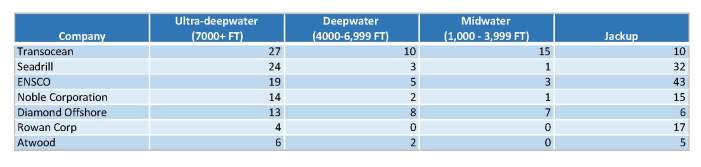
Today, the offshore drilling industry is similarly under duress. The main players are Transocean, Seadrill, ENSCO, Noble Corporation, Diamond Offshore, Rowan Corp & Atwood Oceanics.

A quick review of their investor relations webpages provides the following fleet overview.
OilRigs

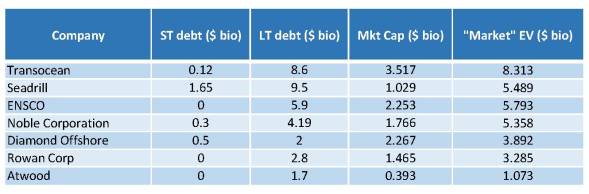
The table below lists the debt, market capitalization and “Market” based enterprise value which essentially accounts for the market value of each company’s debt, not the notional amount.
OilRigs2

Regressing the “Market” EV against the number of rigs, provides an estimate of the market imputed valuation of the various rigs.

Ultra-deepwater           : $190 million

Deepwater & midwater : $94 million

Jackups                          : $45 million

I’ll need to find data on replacement costs to confirm whether or not these are low valuations. I think they are but who knows.

A separate but important thing to note on the industry is the implications of the market cycle. My quick, naive summary of the industry cycle is as follows ….. When oil heads lower, E&P companies cut back by either restructuring existing contracts or not renewing contracts for offshore rigs, the rig companies suffer with unused rigs accumulating, and at some point cry uncle and scrap some of their older rigs. Across the industry, there’s a reduction in the number of offshore oil rigs available and when a recovery in oil materializes, the industry is caught with its pants down and without enough oil rigs, prompting new orders, higher margins. At this point, it’s rinse and repeat.

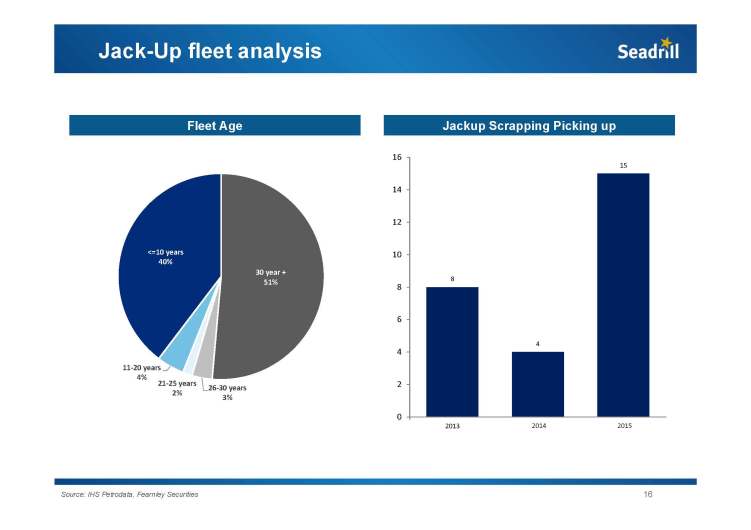
For an industry wide overview on the age of fleets see page 15 & 16 of the following Seadrill presentation, excerpted below. Nearly a third of all floater rigs are over 30 years old and over half of all jackup rigs are over 30 years old. This suggests there could be a significant number of rigs scrapped during this downturn, hopefully making the recovery all the more interesting.
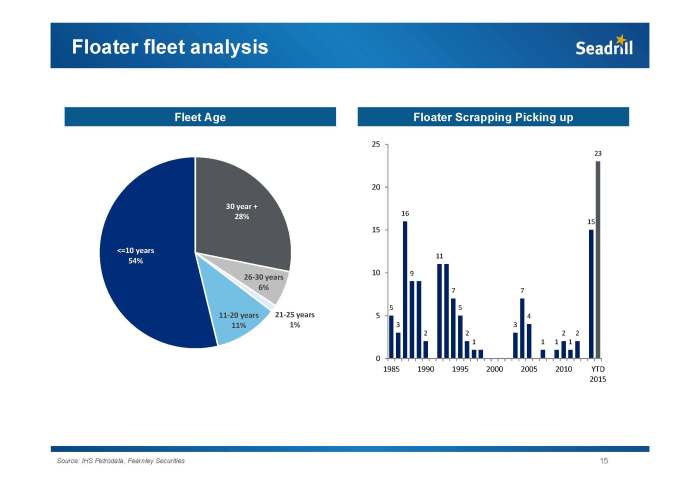
010915-pareto-seadrill-ceo-presentation 15

010915-pareto-seadrill-ceo-presentation 16

I believe an interesting way to play this is via corporate debt. To give you an idea, here are some recent levels.

  1. Ensco 4.70% 3/2021    : 68 cts on the dollar
  2. Ensco 4.50% 10/2024  : 63 cts
  3. Ensco 5.20%  3/2025   :  60 cts
  4. Ensco 5.75% 10/2044   :  56 cts
  5. Diamond 5.875% 5/2019 : 90 cts
  6. Diamond 3.45% 11/2023  : 73 cts
  7. Diamond 5.70% 10/2039 : 64 cts
  8. Diamond 4.875  11/2042 :  58 cts

Disclosure – I own some of the oil rig  bonds and may purchase more.

Two great quotes ….

“History never repeats itself, but it often rhymes.” 

This quote is attributed to Mark Twain and occasionally comes to mind when considering business situations. In the early 2000s, the US steel industry was on its heels. Almost everything in the industry was distressed and bankruptcies were abundant. Into this maelstrom went bankruptcy expert Wilbur L Ross. In just a few years, he acquired and rolled up a number of bankrupt steel companies to be profitably sold to Mittal in 2005.

Is Wilbur Ross Crazy?

The Bottom-Feeder King

Fast forward to today and the quote from John F. Kennedy, the 35th President of the United States comes to mind when considering the energy sector,

“When written in Chinese, the word ‘crisis’ is composed of two characters. One represents danger and the other represents opportunity.”

I can’t help but think that someone like a Ross, a Tisch, a Zell or a Buffett will begin to do a roll up strategy acquiring high quality assets since the major oil & gas companies are too distracted by their own operations & finances to see the opportunity before them.

Case in point, Chesapeake Energy. Yes, a lot can go wrong with this company and they are paying for the sins of the forefathers, but let’s look at some basic & approximate calculations. For starters, they are the 2nd largest natural gas producer in the US.

Top 40 US natural gas producers

Conoco is #7 (Market cap $46 bio), BP (Market cap $92 bio) is #8, Chevron (Market cap $152 bio)  is #10, and Shell (Market cap $118 bio) is #18.

A “market based” enterprise value for Chesapeake = $2.3 bio (Market cap) + $5.15 bio (Market value of $11.4 bio of debt) + $3.3 bio (Minority interests & preferred shares)  – $1.759 bio (Cash) = $9.1 bio

They have 4,377,000 net acres of developed property and 3,656,000 acres of undeveloped property. Assuming the undeveloped land is only worth a quarter of the developed land value would mean the value per acre implied by the market is $9.1 bio / (4.377 mio + 0.914 mio) = $1,714 per acre of developed property and $428 per acre of undeveloped acre.

(Note – I’m unfamiliar with corporate debt and securities law around debt so take what follows with a pinch of salt. I’m just thinking out loud in areas that I have very little experience in but sense an interesting opportunity.)

These prices are significantly lower than where asset sales took place in the past. Which makes me wonder why someone with a stronger balance sheet and desire for a market leading position in natural gas production doesn’t start acquiring Chesapeake’s debt?

If an oil major were to start acquiring the debt they could either be in pole position for the assets during a bankruptcy/restructuring – or – earn a funding carry. Naturally, there’s a big caveat to this. If Chesapeake were to restructure their debt, the covenants could change or the returns diminish (maturity extended, etc.).

In the event that the majors are too preoccupied with their own company affairs, I would envisage a savy Ross, Tisch, Zell, or Buffett like player to enter with a rollup/asset acquisition strategy. Then in 3-5 years when the energy market stabilizes, they sell the entity to a major at a much higher valuation.

As I said, I’m not a credit or bankruptcy expert but the risk/reward from a countercyclical investment in shale gas assets looks as good as it gets. No?

Fromageries Bel, Lactalis & Parmalat

I stumbled upon a few interesting European cheese/dairy companies which piqued my interest in the industry and their businesses. The companies are Lactalis Group (“Lactalis”), Fromageries Bel (“Bel”) and Parmalat.  They are three separate companies with some overlap in shareholder ownership.

Fromageries Bel

Fromageries Bel is France’s third largest pure cheese producer after Lactalis (formerly Besnier) and Bongrain.  Together these three companies produce more than half of the total cheese sales in France, a country with the highest per capita consumption in the world.  You may not be familiar with Bel as a company but you are most likely familiar with their five core products – Mini Babybel®, Boursin®, Kiri®, Leerdammer®, & the Laughing Cow®.


Family business & history

The company was founded in 1865 by Jules Bel in France’s Jura region near the Swiss border. Jules Bel was joined and then succeeded by his son Léon Bel. The younger Bel was responsible for developing and registering a trademark for the Laughing Cow® cheese in 1921. In the 1930s, Léon Bel was joined by his son in law Robert Fiévet and appointed CEO in 1937. If Léon Bel had succeeded in establishing the Laughing Cow ® as successful product, Fiévet would build the company into one of the top three cheese producers in France. Then, in the 1950s their attention moved toward expansion. They reorganized, moved their headquarters to Paris and listed on the Paris Stock Exchange. By the late 1970s, a new generation entered the family-owned business, with the appointment of Bertrand Dufort, Fiévet’s son-in-law. In 1981 the company simplified its current name, to Fromageries Bel.

Interestingly enough, Bel was not alone as a market leader in the French cheese market. Another group, Besnier (today known as Lactalis), was aggressively expanding and consolidating the French dairy industry. Besnier was a private company wholly owned by the Besnier family and led by Michael Besnier. Whereas Besnier and Bongrain had developed a strong presence in the molded cheese segment, Bel had a stronghold on the melted cheese market. In 1993, Besnier began purchasing shares in Bel. By the end of 1994, Besnier (Lactalis) owned 20 percent of Bel. Bel was an easy target but the acquisition never happened.  A separate family holding company, known today as Unibel, was set up in the 1920s and was Bel’s majority shareholder.

As of today, the shareholdings in Fromagerie Bel are as follows – Unibel & family 71% , Lactalis ( formerly Besnier) 24%, Treasury shares 1.5%, Other shareholders (free float) 3.5%. Yep, that’s right. Only 3.5% of the float is available and not locked up. We’ll come back to this point later.

Lactalis

Groupe Lactalis, formerly known as Besnier, is France’s largest dairy products producer and one of the largest cheese manufacturers in the world. It ranks second in the global dairy market, after Nestle. Whereas you may never heard of the company, you will most likely be familiar with the company’s renowned President label and other brands such as Sorrento, Rondele, etc.  Lactalis is a private company 100% owned by the Besnier family.

Lactalis

Family business & history

Besnier S.A., today known as Lactalis, was founded in 1933 by Andre Besnier in Laval, in the Loire Valley region of France. Besnier remained a small, single factory operation well into the 1960s. Andre’s son, Michel Besnier, took over operations in the late 1950s with a goal to expand its operations to multiple plants and diversify the company’s dairy products. As a first step, Besnier created its own brand, the famous President Camembert label, in 1968. From the next year onwards, Michel Besnier pursued a series of acquisitions through the 1970s, 1980s, 1990s, and 2000s which catapulted the private company into the 2nd largest dairy company in the world.

http://www.lactalis.fr/english/groupe/historique.htm

Parmalat

Parmalat was founded by Calisto Tanzi in 1963 in Italy. From the start, the business pursued the expansion of new milk products which led to their flagship product – milk pasteurized at ultra-high temperatures. This was revolutionary at the time because it maintained an unrefrigerated shelf life that exceeded six months before opening. Parmalat expanded from such humble beginnings to become a large multinational firm in the late 1990s, becoming the largest Italian food company and fourth largest in Europe at the time.

Unfortunately, an accounting scandal of epic proportions was discovered in 2003 leading to Parmalat’s bankruptcy.  A new Parmalat was listed on the Italian stock exchange in October 2005.

In 2011, Lactalis bought an additional 54% of Parmalat. This took Lactalis stake in the publicly listed company to 83.3% after accounting for the 29% of the company already owned before the additional acquisition.  This means only 16.7% of the common equity is freely available. We’ll come back to this point later.

Investment thesis

I purchased shares in Fromageries Bel for the following reasons.

Financials

  • Their financials are decent. Here’s a decent CFA Society writeup on the company.
  • Solid cash flow generation allows the company to finance capital expenditures with internal financing.
  • Demonstrated long term track record of performance – delivering quality products & strong financials.

Favorable backdrop

  • Lactalis under the Besnier family appear to be an Outsider like firm which excels at acquisition and consolidation in the dairy industry.
  • Of the companies owned by Lactalis, I believe only Fromageries Bel and Parmalat are publicly listed equities but not wholly owned.
  • There is the potential for the shares not in the controlling shareholder’s hands, Lactalis’ hands, to eventually be bought out or tendered for to gain 100% ownership.

Why Fromageries Bel and not Parmalat?

I believe the incentives are better aligned in Fromageries Bel. I am working under the assumption that since Lactalis, a direct competitor, has a 24% stake in Fromageries Bel it would be hard for the Bel family or Fromageries Bel’s management to get away with any shenanigans. This counterbalance does not seem to exist amongst the shareholdings of Parmalat.

Cheese financials